Upper Tract Urothelial Cancer Treatment in Bhubaneswar
Dr. Rahul Pradhan, a leading Uro-Oncologist and Urologist in Bhubaneswar, offers advanced robotic and laparoscopic treatment for UTUC. Having performed over 300 major uro-oncology surgeries at Bagchi-Sri Shankara Cancer Centre and Rahat Hospitals, he provides international-standard cancer care in Odisha, reducing the need for patients to travel to metro cities.
300+
MCh
FMAS
9+
Types of Upper Tract Urothelial Cancer Treated By Dr. Rahul Pradahn
UTUC is classified based on its location, depth of invasion, and grade. Accurate classification is critical because it directly determines the treatment approach.
By Location
- Renal Pelvis Cancer: Develops in the central collecting area of the kidney. Accounts for the majority of UTUC cases.
- Ureteral Cancer: Arises in the ureter, the tube connecting the kidney to the bladder. Less common but often more aggressive.
By Stage
- Non-Muscle-Invasive UTUC (Ta, T1, CIS): The tumour is limited to the inner lining and has not invaded deeper tissues. Often eligible for kidney-sparing treatment.
- Muscle-Invasive UTUC (T2 and above): The tumour has grown into the muscular wall, with potential spread to lymph nodes or distant organs. Requires aggressive treatment, usually radical surgery.
By Grade
- Low-Grade Tumours: Slower growing and less likely to invade deeply.
- High-Grade Tumours: Faster growing with a higher risk of progression and metastasis.
Book Your Consultation Today
Noticed a lump, swelling, or unusual heaviness? Do not wait. Early evaluation makes all the difference in testicular cancer outcomes.
What are the Signs and Symptoms of Upper Tract Urothelial Cancer
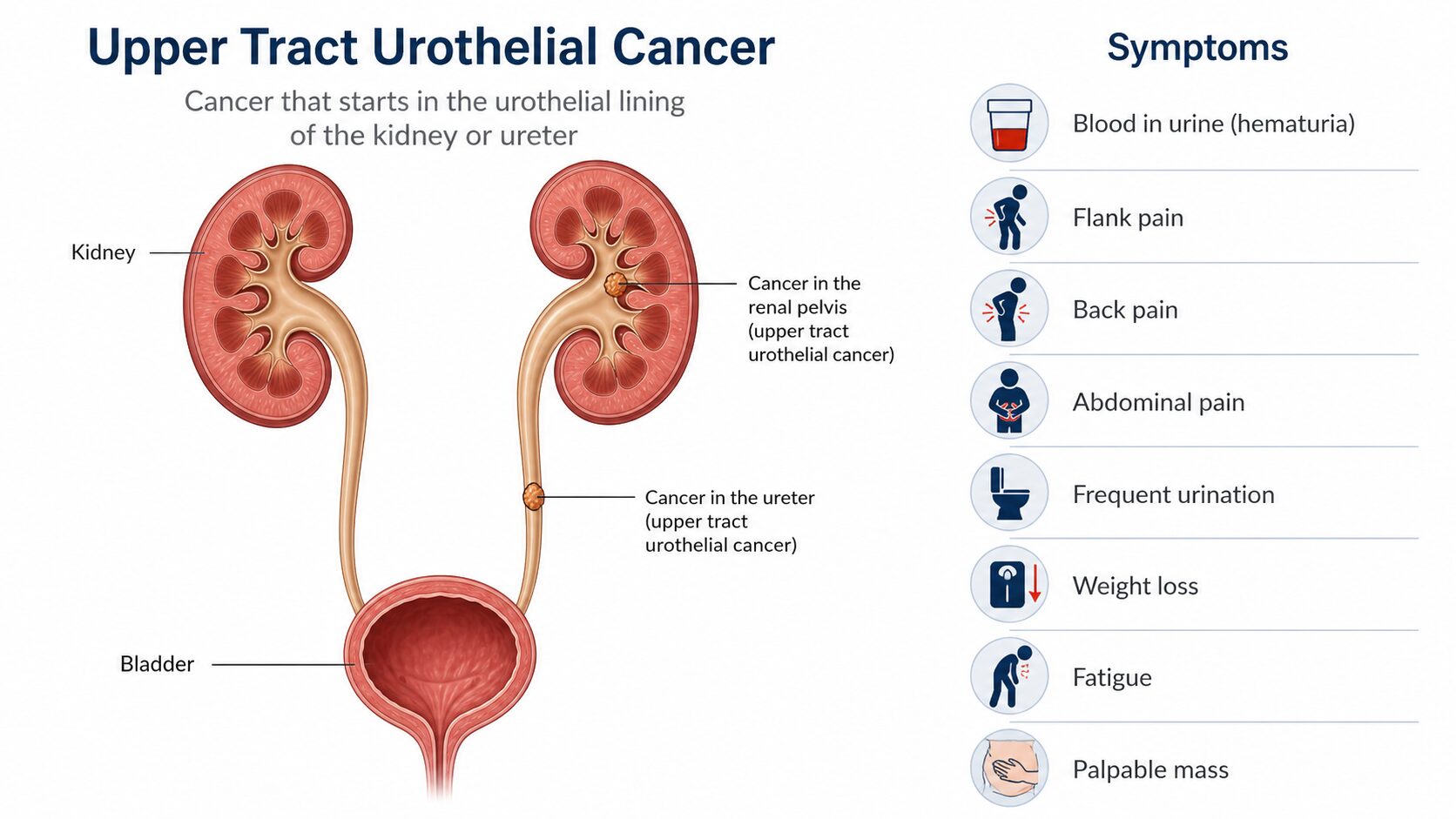
UTUC often produces few symptoms in the early stages, which makes timely diagnosis critical. The most common warning signs include:
- Blood in Urine (Haematuria): Visible or microscopic blood in the urine is the most frequent symptom, occurring in 70 to 80 percent of patients. The same symptom is also a common warning sign of bladder cancer, and the two conditions often need to be evaluated together.
- Flank Pain: A dull or persistent ache on one side of the lower back, often caused by tumour obstruction or hydronephrosis.
- Lower Back or Abdominal Pain: May indicate larger tumours or local spread.
- Painful or Frequent Urination: Less common but possible, especially with ureteral tumours.
- Unexplained Weight Loss or Fatigue: Suggestive of advanced disease.
- Palpable Mass: Rare, usually associated with very large tumours.
If you notice any of these symptoms, particularly blood in the urine, consult an experienced urologist promptly. Early diagnosis significantly improves treatment outcomes.
Causes of Upper Tract Urothelial Cancer
UTUC develops when cells in the urothelial lining grow abnormally and form tumours. Several factors raise the risk:
Smoking:
The single biggest risk factor. Smokers have a three to seven times higher risk of developing UTUC.
Occupational Exposure:
Long-term contact with aromatic amines used in dye, leather, rubber, and chemical industries.
Aristolochic Acid Exposure:
Found in certain herbal medicines and contaminated food. A known cause of UTUC in parts of Asia and the Balkans.
Lynch Syndrome (HNPCC):
A hereditary condition that significantly raises the risk of urothelial and other cancers.
History of Bladder Cancer:
Patients with a previous bladder cancer carry a higher risk of UTUC.
Chronic Urinary Tract Inflammation:
Long-standing irritation, infections, or stones in the urinary tract.
Diagnostic Procedures for Upper Tract Urothelial Cancer
Accurate diagnosis is essential to determine the exact location, stage, and grade of UTUC. Dr. Rahul Pradhan uses a comprehensive set of evidence-based investigations:
Urine Cytology:
Examines urine under a microscope for cancer cells. Particularly useful for detecting high-grade disease.
CT Urography:
The gold standard imaging test. Provides detailed images of the kidneys, ureters, and bladder to identify tumours and assess spread.
MRI Urography:
Used when contrast dye in CT is unsafe, offering high-quality images of the urinary tract.
Ureteroscopy with Biopsy:
A thin flexible scope is passed through the urethra into the ureter or renal pelvis to directly visualise and sample suspicious lesions.
Cystoscopy:
Inspects the bladder to rule out coexisting bladder tumours, since UTUC and bladder cancer often occur together.
FISH and Molecular Markers:
Advanced tests that detect chromosomal abnormalities in urine for early or borderline cases.
Ureteroscopy with Biopsy:
A thin flexible scope is passed through the urethra into the ureter or renal pelvis to directly visualise and sample suspicious lesions.
What Treatment Options are Available for UTUC in Bhubaneswar
Treatment depends on tumour location, grade, stage, kidney function, and the patient’s overall health. Dr. Rahul Pradhan offers a complete range of evidence-based treatment options:
Kidney-Sparing (Endoscopic) Treatment
For low-grade, low-volume tumours, kidney function can often be preserved.
- Ureteroscopic Laser Ablation: A laser fibre is passed through the ureteroscope to vaporise the tumour. Ideal for small tumours, patients with a single kidney, or those with reduced renal function.
- Percutaneous Tumour Resection: Used for tumours in the renal pelvis that are difficult to reach via ureteroscopy.
Radical Nephroureterectomy (RNU)
The standard treatment for high-risk or muscle-invasive UTUC. The procedure involves removing the entire kidney, the ureter, and a small bladder cuff at the ureteral opening.
- Robotic Radical Nephroureterectomy: Performed using the Da Vinci robotic system for enhanced precision, smaller incisions, less blood loss, and faster recovery.
- Laparoscopic Nephroureterectomy: A minimally invasive option for selected cases.
- Open Surgery: Reserved for very large or complex tumours where direct surgical access is required.
Lymph Node Dissection
In high-grade or muscle-invasive cases, regional lymph nodes are removed and examined to check for cancer spread and guide further treatment. The same principle of regional lymph node clearance also applies in other genitourinary cancers, such as penile cancer, where inguinal node dissection is a key step in staging and control.
Adjuvant Intravesical or Intracavitary Therapy
After surgery, medications such as Mitomycin C or BCG may be instilled into the bladder or upper tract to reduce the risk of recurrence.
Systemic Chemotherapy and Immunotherapy
For advanced or metastatic UTUC, chemotherapy regimens such as Gemcitabine-Cisplatin and modern immunotherapy agents are coordinated through a multidisciplinary team.
Surveillance and Follow-Up
Regular cystoscopy, imaging, and urine tests are essential for early detection of recurrence, which is common in UTUC.
Book Your Consultation Today
Get specialised robotic and laparoscopic UTUC treatment in Bhubaneswar consult Dr. Rahul Pradhan today.
Our Approach and Procedure
Every UTUC patient at our centre receives a personalised, multidisciplinary care plan. The approach follows a clear pathway designed for accuracy, comfort, and optimal outcomes:
—– Urology Specialist in Bhubaneswar
Why Choose Dr. Rahul Pradhan for UTUC Treatment
Dr. Rahul Pradhan brings together academic depth, surgical precision, and patient-focused care to every UTUC case. He holds an MBBS, MS in General Surgery, MCh in Urology, and a Fellowship in Minimal Access Surgery (FMAS), with over 9 years of dedicated experience and 300 plus major uro-oncology surgeries performed using the Da Vinci robotic system.
He is trained at Sri Shankara Cancer Foundation, Bangalore, one of India’s top five centres for robotic prostate and uro-oncology surgery, and is certified in Da Vinci robot surgery by Intuitive Surgical, USA. He has co-authored a chapter in the Academy of Uro-Oncology 2024 and serves as a peer reviewer for the International Journal of Surgery.
Patients choose Dr. Rahul Pradhan for his ethical practice, evidence-based decision-making, and clear communication, with a strong emphasis on kidney-sparing approaches whenever clinically possible.

MBBS, MS, MCh (Urology): complete surgical and urological training.

Post-Doctoral Fellowship in Uro-Oncology: trained at Sri Shankara Cancer Foundation, Bengaluru, one of India’s top five centres for uro-oncology.

300+ Major Robotic Surgeries: including complex oncological procedures with minimally invasive approaches.
FMAS: specialised training in laparoscopic and robotic techniques.
Subspecialty in Uro-Oncology:Subspecialty in Uro-Oncology: prostate, kidney, bladder, testicular, and penile cancers.
Multidisciplinary Coordination: seamless links with medical oncology and radiation oncology for integrated care.
Patient-First Approach: clear communication, transparent cost estimates, and honest advice on when to treat and when to watch.
For patients across Bhubaneswar, Cuttack, Puri, and the rest of Odisha, this means access to complete testicular cancer care, alongside related uro-oncology services such as penile cancer, from first consultation to long-term follow-up, without leaving the state.
Patient Education Videos
Latest Blog
Does Smoking Increase the Risk of Bladder Cancer? Causes, Warning Signs and Prevention
Most individuals when questioned about the effects of smoking on the organ systems would talk about lungs. However, when it comes to bladder, not many think of smoking as it is one of the leading factors contributing to its pathologies, being cited in half of the...

What Are Early Symptoms of an Enlarged Prostate?
Pain isn’t how an enlarged prostate usually announces itself. The first symptoms of an enlarged prostate show up at the toilet instead. The gland sits around the urethra, so as it grows it narrows the channel urine has to pass through. Doctors call the condition...
Can a Bladder Infection Cause Bleeding? Causes, Symptoms and When to Seek Care
Medically Reviewed by Dr. Rahul Pradhan, MBBS, MS, MCh (Urology) · Urologist & Uro-Oncologist, BhubaneswarWhy blood shows up with a bladder infection, what else to watch for, and when it’s time to see a doctor.Seeing blood in your urine is frightening, even...
—– Common Questions —–
FAQs
What is Upper Tract Urothelial Cancer (UTUC)?
UTUC is a cancer that develops in the urothelial lining of the renal pelvis or ureter, the channels that drain urine from the kidneys to the bladder. It accounts for about 5 to 10 percent of all urothelial cancers and is less common than bladder cancer.
Is UTUC curable?
Yes. When diagnosed early, UTUC is highly treatable and often curable. Low-grade and non-invasive tumours can be managed with kidney-sparing surgery, while high-grade or muscle-invasive cases are treated with radical nephroureterectomy. Regular follow-up is essential to monitor for recurrence.
What is the most common symptom of UTUC?
Blood in the urine, called haematuria, is the most common symptom and occurs in 70 to 80 percent of patients. Flank pain and unexplained weight loss may also appear. Any blood in the urine should be evaluated promptly by a urologist.
How is UTUC diagnosed?
Diagnosis involves urine cytology, CT urography, ureteroscopy with biopsy, and cystoscopy. CT urography is considered the gold standard imaging test. Molecular tests may be added in selected cases.
What is the standard surgery for UTUC?
Radical nephroureterectomy is the standard surgery for high-risk UTUC. It involves removing the kidney, the entire ureter, and a small bladder cuff. Dr. Rahul Pradhan performs this using the Da Vinci robotic system for precise, minimally invasive results.