
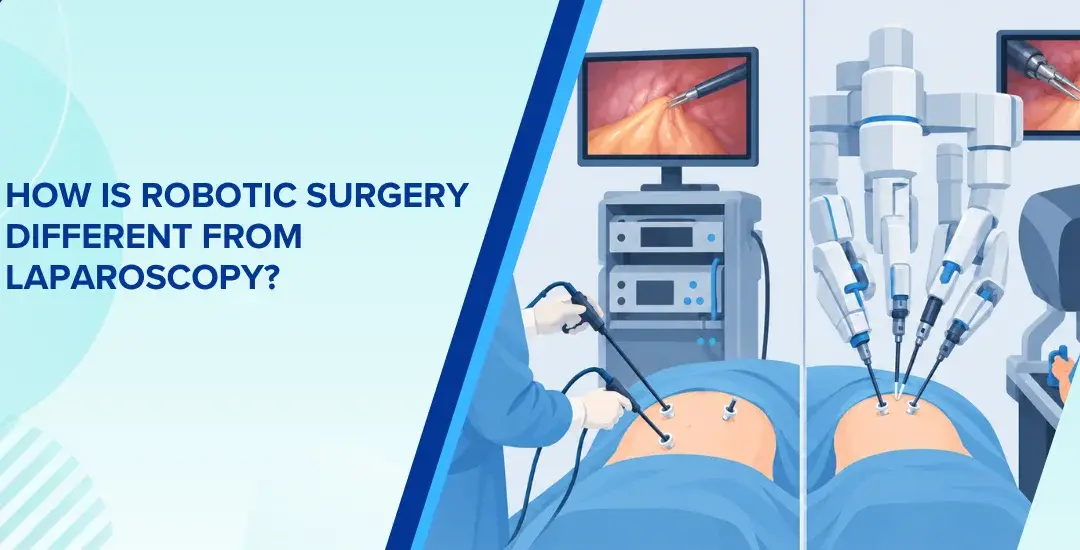
Both robotic surgery and laparoscopy count as minimally invasive. The difference is in how they are performed. In robotic surgery, the surgeon sits at a console, guiding robotic arms through movements that are filtered and steadied along the way. In laparoscopy, the surgeon stands at the operating table, using long, rigid instruments. Smaller cuts and quicker healing than open surgery—the goal stays the same either way. Just two different roads to it.
According to Dr. Rahul Pradhan, one of the best Urology Doctor in Bhubaneswar and consultant uro-oncologist, “Patients often assume robotic means a machine is operating. It isn’t. Every movement on that console comes from the surgeon’s hands, just translated with more precision and a steadier view.”
How Does Robotic Surgery Actually Differ From Laparoscopy?
Small incisions, sure, both use them. But the tools and the technique differ significantly after that.
Feature | Robotic Surgery | Laparoscopic Surgery |
Vision | 3D magnified view via console | 2D flat-screen view |
Instrument Movement | Wristed, multi-directional | Straight, limited-angle |
Surgeon Position | Seated at console | Standing at operating table |
Tremor Control | Filtered and steadied | Unfiltered, hand-dependent |
Access matters more than people think. Laparoscopic setups sit in nearly every major hospital, so it’s the option that’s easier to schedule and quicker to access. Robotic systems, on the other hand, are still available in a smaller number of larger centres. The equipment costs more, and so does training a team to use it. So neither wins outright. A routine gallbladder removal does not need a robotic console. But a procedure needing fine suturing deep in the pelvis? That’s where the extra dexterity starts to matter. What the surgery actually demands decides the tool, not the other way round.
Patients whose case leans toward the more accessible option can learn more through a consultation for laparoscopic surgery.
When Is Robotic Surgery Preferred Over Laparoscopy?
Not every case calls for a robotic approach. A few situations tip the scale toward it.
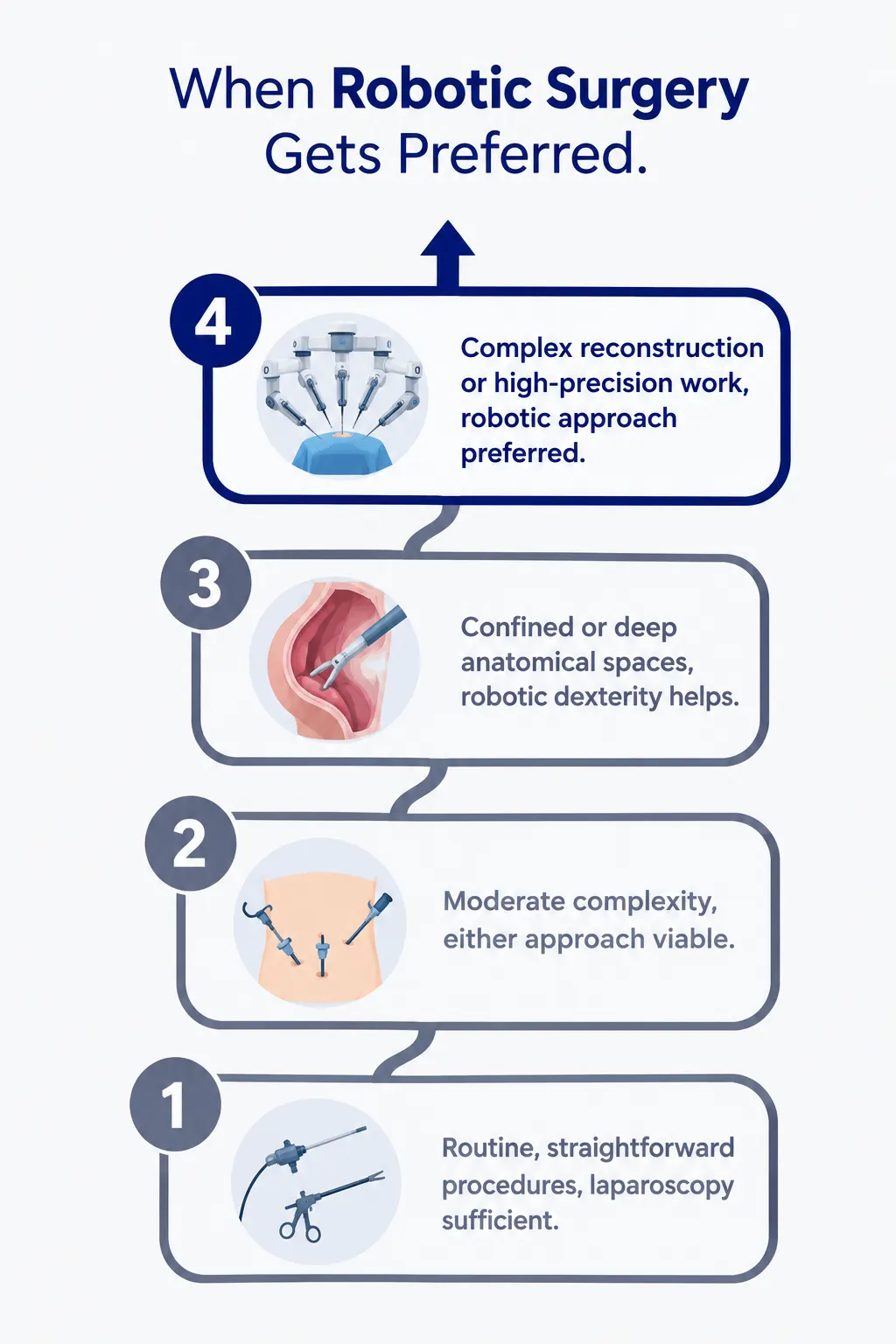
- Complex reconstructions: Procedures needing internal suturing, partial nephrectomy or prostatectomy, for instance, lean on the wristed movement robotic tools provide.
- Confined spaces: Deep pelvic work goes smoother with instruments that bend and rotate instead of straight laparoscopic ones.
- High precision needs: A tumour sitting close to a major vessel or nerve needs tremor-filtered, steady hands. Robotic arms deliver that.
- Cost and access: Laparoscopy stays cheaper and more available, and for routine cases without added complexity, that’s usually enough.
Choosing between the two gets harder in cancer cases, where the anatomy rarely cooperates. Our piece on tumor thrombus surgery walks through exactly this kind of call for kidney cancer.
Why Choose Dr. Rahul Pradhan?
Dr. Rahul Pradhan has performed 300+ robotic and minimally invasive surgeries, trained on the Da Vinci Surgical Robot at Sri Shankara Cancer Foundation, Bangalore. His credentials include an MBBS, MS in General Surgery, MCh in Urology, and a Fellowship in Minimal Access Surgery. He doesn’t default to one technique across the board, choosing the surgical approach based on each patient’s individual anatomy and case complexity.
Curious which approach fits your procedure?
FAQs
Does laser prostate surgery hurt?
Anaesthesia keeps pain minimal during the procedure itself.
How long is recovery after laser prostate treatment?
Normal activities usually resume within about a week.
Do I need a catheter after the procedure?
Yes, typically for a day or two during healing.
Does the procedure affect sexual function?
Ejaculation may change afterward, but erectile function typically remains normal.
Disclaimer: This content is for general informational purposes only and is not a substitute for professional medical advice, diagnosis, or treatment.