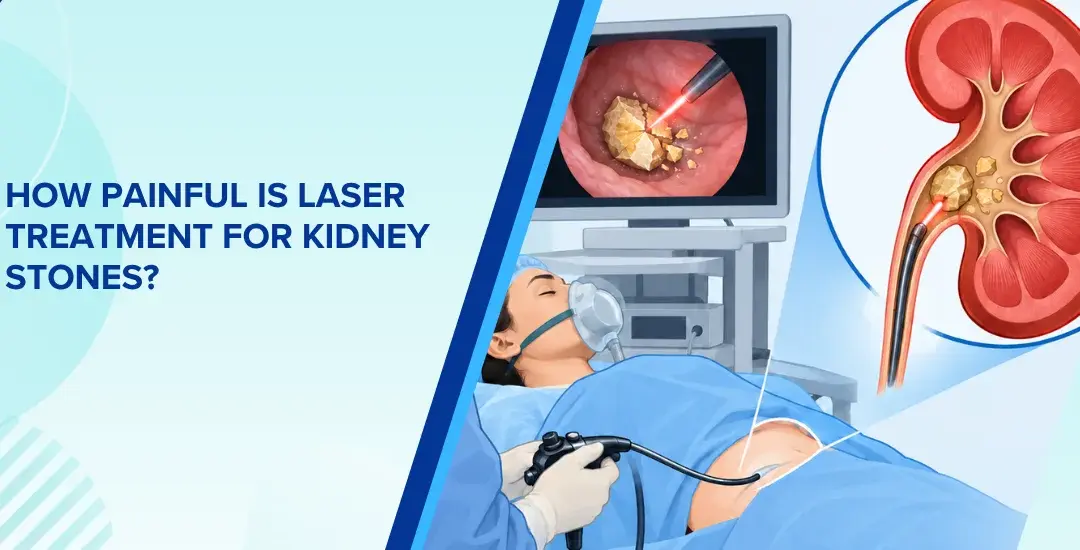
Most people expect the treatment to hurt as much as the stone did. It doesn’t work that way. Laser treatment for kidney stones is carried out under general anaesthesia or deep sedation, so there’s simply nothing to feel while it’s happening. The flank pain, the sharp cramping, that’s the stone itself acting up beforehand, not anything the laser does. A little soreness can turn up once the sedation wears off, but give it a few days and it usually settles on its own.
According to Dr. Rahul Pradhan, a Urologist in Bhubaneswar and consultant uro-oncologist, “The stone itself causes the real pain, not the treatment. Once the patient is under anaesthesia for laser lithotripsy, they feel nothing during the procedure and wake up in recovery afterward.”
Does Laser Treatment for Kidney Stones Hurt During the Procedure?
Short answer: no. Here’s the reasoning behind it.
- Anaesthesia handles the sensation: Whether it’s general anaesthesia or deep sedation, the patient simply isn’t conscious enough for pain to register while the laser works.
- Nothing gets cut open: The laser travels up through the urinary tract itself. There’s no incision, so there’s nothing at a surgical site to hurt in the first place.
- Someone’s watching the whole time: Heart rate, oxygen, blood pressure, all of it gets tracked continuously by the anaesthesia team. Patients stay unaware of it entirely.
- It doesn’t drag on: Most sessions finish in under an hour, which keeps time under anaesthesia fairly brief.
Anyone still unsure what actually happens during the procedure can get a clearer picture through a consultation for laser stone surgery.
What Kind of Discomfort Can You Expect After Laser Stone Treatment?
The procedure is performed under anaesthesia, so you don’t feel pain during surgery. Recovery asks a little more of you, though it’s usually manageable.
- A burning feeling when urinating: This tends to show up for a day or two while things settle down internally. Extra water tends to help.
- Some blood in the urine: Don’t be alarmed by light pink or red tinging early on. It’s expected, and it clears within a day or two for most people.
- A stent, if one’s placed: Can bring pressure or make you feel like you need to urinate more often than usual.
- Pain relief rarely needs to go further than basic: An over-the-counter option is usually all it takes. Prescription-strength painkillers are rarely called for.
How rough that recovery feels often traces back to one thing: how big the stone was to start with. Our guide on kidney stone size gets into that connection in more detail.
Why Choose Dr. Rahul Pradhan?
Dr. Rahul Pradhan has over 9 years of clinical practice, with substantial hands-on experience in laser and minimally invasive stone procedures. He holds an MBBS, MS in General Surgery, and MCh in Urology. His approach favours precision and a case-by-case technique over a fixed routine, drawing on that surgical background with every patient he treats.
Wondering what to actually expect during laser stone treatment?
FAQs
Is laser treatment for kidney stones painful?
No pain during the procedure itself, since it’s done under anaesthesia.
How long does soreness last after laser stone treatment?
A few days, typically, before things settle back to normal.
Is blood in urine normal after laser lithotripsy?
Yes, mild tinging for a day or two is nothing unusual.
Will I need strong painkillers after the procedure?
Not usually. Over-the-counter pain relief is often enough.
Disclaimer: This content is for general informational purposes only and is not a substitute for professional medical advice, diagnosis, or treatment.